MENU

Floor Heating

SCREED HEATING.

Screed heating warms significantly faster than an in-slab pour — the natural choice when polished concrete is already part of the plan.

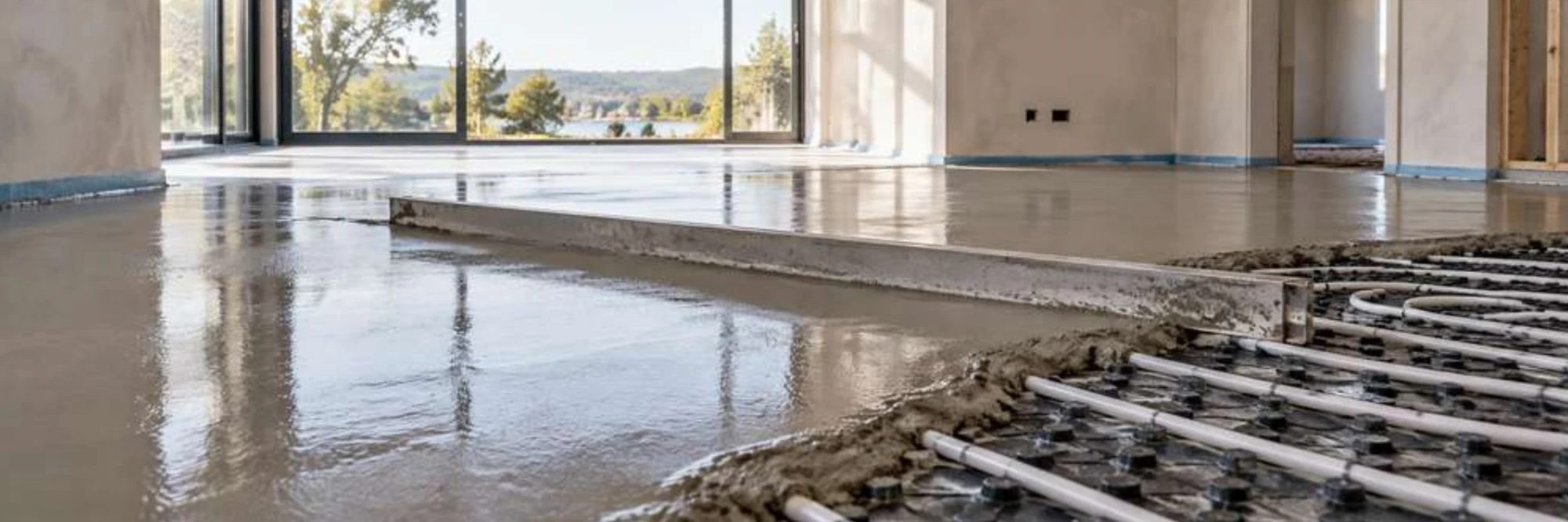
Screed being poured and levelled with a straightedge over hydronic underfloor heating pipe in a bright new-build living room

Faster heat, R1-rated efficiency.

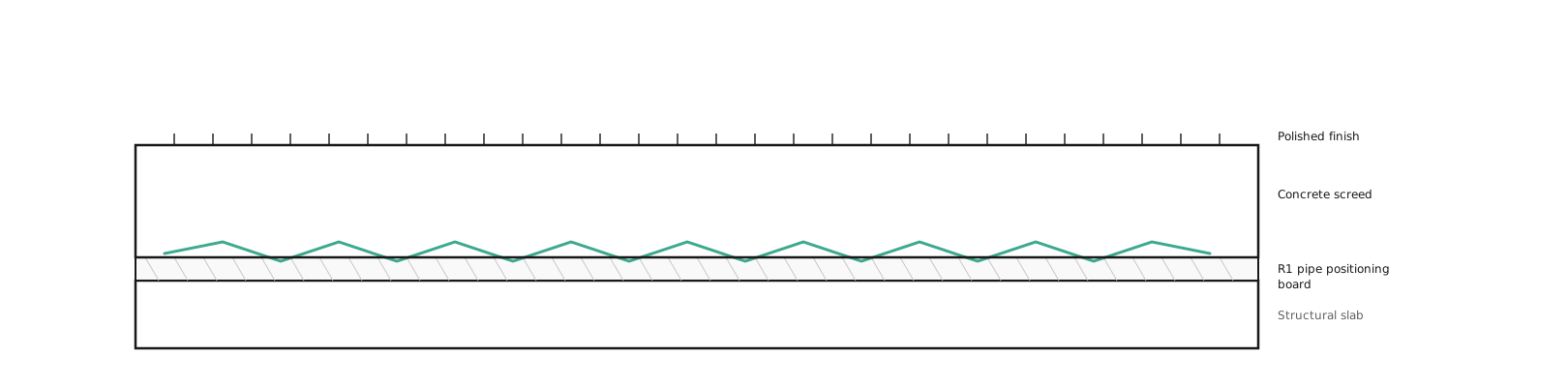
Pipe is secured into an insulated, R1-rated pipe positioning board laid directly on the structural slab, then covered with a concrete screed. The board stops heat escaping downward, so more of it radiates up through your polished concrete floor — with far less mass to warm than a full in-slab system.

Cross-section of a screed heating system: R1 pipe positioning board on the structural slab, hydronic pipe secured to the board, concrete screed poured over, polished finish

Cutaway — R1 board and pipe over structural slab, screeded and polished

01

Board laid on structural slab

An R1-rated pipe positioning board is laid directly on the existing structural slab, stopping heat loss downward.

02

Pipe secured at 200mm centres

Pipe clips into the board’s positioning knobs at 200mm spacing, connected to the manifold and pressure tested.

03

Screeded & polished

A concrete screed is poured over the system, then polished or finished to suit — coordinated with your concretor.

Screed vs. Slab Heating.

Screed

Best For

Polished concrete finishes, and homes that want faster day-to-day response.

Floor Build-Up

R1 board and pipe, screeded over the structural slab.

Heat-Up Time

Warms significantly faster than a full slab pour — exact figure confirmed with your quote.

Slab

Best For

New builds wanting the most affordable whole-floor system.

Floor Build-Up

Pipe cast directly into the structural slab pour — no added layer.

Heat-Up Time

Around 24 hours from cold, holding heat efficiently once up to temperature.

When screed makes the most sense.

Polished Concrete

The natural choice when a polished concrete finish is already part of the plan — the system installs before the pour.

Fast Response Needed

Far less thermal mass than a full slab, so the room — and your setting changes — come up to temperature faster.

Board, Pipe & Screed.

An R1-rated pipe positioning board is laid on the structural slab, with pipe secured at 200mm centres and connected back to the manifold for pressure testing before the pour.

A concrete screed is poured directly over the board and pipe. Exact screed depth and total finished-floor-level build-up depends on your slab, mesh and chosen flooring — we confirm this as part of your design.

Two Trades, One Floor

Budget for two trades.

Screed heating has two components to cost: the dPP hydronic install — pipe, board and manifold — and the concrete pour and polishing carried out by your concretor. We coordinate timing with your builder, but the concrete and finishing cost sits separately with your concretor.

dPP +
Concretor

LET’S BUILD INVISIBLE COMFORT.

Tell us about your build and we’ll design a screed heating system to suit — supplied and installed by our own employed technicians.

FAQ

Common
questions.

Can’t find what you’re looking for? Get in touch.

Screed heating responds significantly faster than a full in-slab system, because there is far less concrete mass to bring up to temperature. We’ll talk you through the expected response time for your specific build as part of your quote.

Two trades are involved: dPP supplies and installs the hydronic system, while your concretor pours and polishes the screed on top. We coordinate timing with your builder, but the concrete and polishing cost sits with your concretor, separate from our quote.