MENU

Floor Heating

SLAB HEATING.

The most cost-effective way to warm an entire new home — heat built into the foundation itself.

Slab heating installation photograph

Your whole floor, as the radiator.

Pipe is laid within the slab before the pour. Once connected, the boiler heats water to around 50°C and circulates it through the slab, turning your entire floor into a giant, gentle radiator — much like a brick wall releasing the day’s warmth after sunset. Because there’s no forced air, there’s no dust movement, which is a genuine relief for allergy sufferers.

Slab heating cross-section diagram

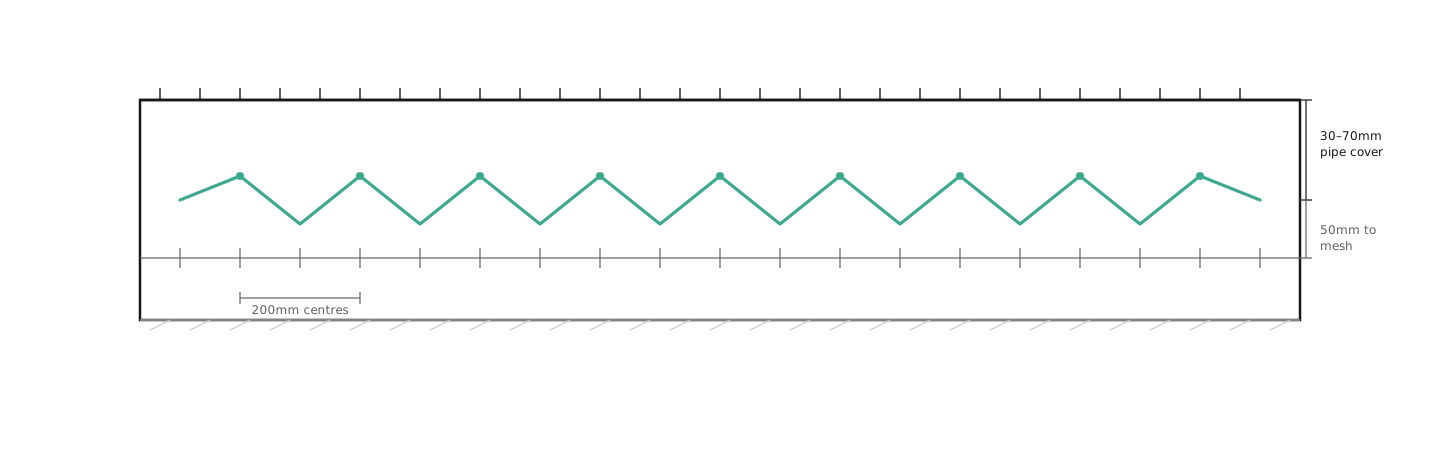
Cross-section — pipe cast into the slab at 200mm centres

Slab step pipe cast icon

01

Pipe cast into the slab

Pipe is fixed to the mesh reinforcement before the structural pour.

Slab step boiler icon

02

Boiler heats to ~50°C

Warm water circulates continuously through the slab’s pipe network.

Slab step radiates icon

03

Radiates through the home

The whole floor releases gentle, even warmth for hours at a time.

Key Benefits

01

Whole-home coverage at the lowest cost per m².

02

No moving air — allergen-friendly by design.

03

Ideal for new builds where the slab is being poured anyway.

What’s it going under?

Works well with tile, stone and engineered timber. Solid timber and glue-down floors are not recommended due to heat sensitivity.

Slab floor tile icon

Tile

Suitable

Slab floor stone icon

Stone

Suitable

Slab floor eng timber icon

Engineered Timber

Suitable

Slab floor solid timber icon

Solid Timber / Glue-down

Not recommended

Pipe Layout & Cover Depth.

Pipe is secured to the slab’s mesh reinforcement at 200mm spacing. We lay it in a spiral pattern where possible — it balances heat output more evenly than a serpentine (back-and-forth) run, which we reserve for tighter or more complex areas. Maximum run length is 100m per loop.

Pipe cover depth depends on your final flooring: as little as 30mm under covered floors like tile, up to around 70mm for a polished or exposed slab. The reinforcing mesh itself sits roughly 50mm down.

Because the whole slab is heated, slab systems respond more slowly than a screed or timber system — expect around 24 hours to warm from cold. Once up to temperature, a well-insulated slab holds heat efficiently, so most homes run continuously at a low, steady setting rather than cycling on and off.

Need something faster?

Need a faster response?

Slab systems take around 24 hours to warm from cold. If you want quicker control over room temperature — or you’re building on an existing slab — Screed heating responds significantly faster, with far less concrete mass to bring up to temperature.

Faster

Response vs. slab

LET’S BUILD INVISIBLE COMFORT.

FAQ

Common
questions.

Can’t find what you’re looking for? Get in touch.

Because pipe is cast directly into the slab, it’s installed during the existing slab-pour stage of your build — there’s no extra construction step of its own. Once your home is complete and the system is commissioned, expect around 24 hours for the slab to warm from cold.

Slab heating is the most cost-effective way to heat a whole home per square metre, since your existing structural slab becomes the heat-emitting surface — no additional radiators or floor build-up required. Actual running costs depend on insulation and floor area, which we model as part of your quote.